

Straightforward solar for homeowners
Save Money By Going Solar.
Explore solar options designed around your home, energy use, and financial goals — without confusing industry jargon or high-pressure sales tactics.
Estimates and financing options depend on property, energy use, system design, utility rules, and qualification.
- No-cost, no-obligation estimateUnderstand your options before committing to anything.
- Plain-language comparisonsOwnership, loan, lease, and PPA explained side by side.
- Built around your billYour actual usage drives the numbers, not a generic average.
- Coordinated with qualified partnersWe help you compare, then coordinate the next steps.
Why Homeowners Look at Solar
Reasons people start the conversation
Every property is different, and so is every reason. These are the ones we hear most often — whether they apply to your home depends on your roof, your usage, and your utility.
Rising utility rates
Electricity prices are set by your utility and can change over time. Producing some of your own power changes how much you buy at those rates.
A bill that keeps climbing
Households add EVs, heat pumps, and air conditioning. Solar is one way to address a bill that grows as your home uses more.
Predictability
A fixed monthly payment for a system can be easier to plan around than a utility bill that moves with the season.
Backup during outages
Battery storage is optional, and it changes both the cost and the design. Whether it makes sense depends on your priorities.
Work you were already planning
Some homeowners look at solar alongside a roof replacement or an electrical panel upgrade, because the work overlaps.
Incentives
Federal, state, and utility incentives exist but change, and eligibility depends on your situation. We point you to what applies rather than assume it does.
Start with your bill
The most accurate estimate starts with your power bill
Upload a recent power bill so we can review your actual energy use and prepare a more accurate solar estimate.
We ask for the bill only to review your energy use. See our Privacy page for how information is handled.
No-cost, no-obligation estimate
Reviewing your bill costs nothing and commits you to nothing.
Built around actual usage
Your real consumption drives the numbers, not a generic average for your area.
Saves time and improves accuracy
A recent bill answers most of the questions we would otherwise have to ask you.
Final pricing and savings depend on property conditions, utility rules, system design, financing, and qualification.
How it works
Three steps to a clear answer
Most homeowners get from a first conversation to a personalized proposal without leaving the kitchen table.
Share your power bill
Your recent bill shows what you actually use and what you actually pay. That is the starting point for everything else.
Review your options together
We look at your roof, your usage, and your goals, then walk through the ownership and payment pathways that fit.
Get a personalized proposal
You receive a proposal built around your property, with the assumptions written down so you can check them.
Ownership and payment
More than one way to go solar
These are the common pathways. Not every option is available to every homeowner, and availability depends on the provider, your property, and your qualification.
Cash purchase
You own the system outright from day one.
What that means in practice
- No monthly financing payment
- You hold any applicable incentives
- Highest upfront cost
Solar is never free. Zero-upfront-cost options such as some leases and power purchase agreements may be available to qualified homeowners, which means no money at signing — not that the system costs nothing.
Rising utility rates
Protect yourself from rising utility rates
Utility rates are set by your provider and approved by regulators. They have generally moved upward over time, and neither you nor we control them.
Producing some of your own electricity changes how much you buy at those rates. It does not end your relationship with the utility — you stay connected to the grid, and most homeowners still receive a bill.
What solar can do is change the shape of that bill. How much, and whether it makes financial sense, depends on your usage, your roof, your utility's rules, and the option you choose.
We do not publish savings figures or percentages. Any numbers you see from us will be tied to your own bill, with the assumptions written down.
Where to start
Residential and commercial
The questions are different, so the process is too. Pick the one that matches your property.
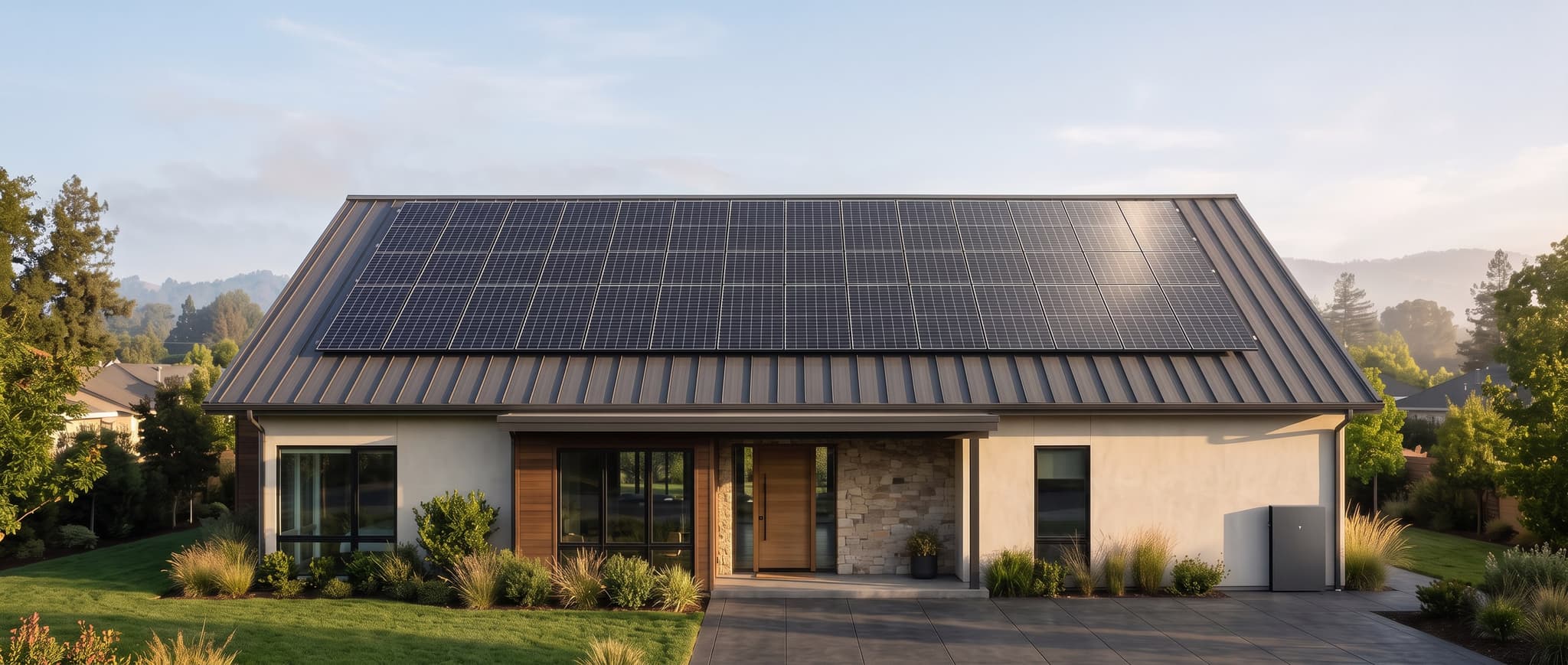
Solar for your home
Roof condition, shading, household usage, and your utility's rules shape what a system looks like — and which payment options are worth comparing.
- Roof, shading, and orientation review
- Household usage from your actual bill
- Ownership, loan, lease, and PPA comparison
- Optional battery storage
Not sure which one you are?
Choose the option that best describes your situation.
This is a starting point, not an eligibility determination.
How the pieces connect
From sunlight to the evening
How solar and storage relate to each other across a single day — the same day the hero moves through.
Sunlight reaches the panels
Generation follows the sun — strongest in the middle of the day, tapering at either end.
Panels produce electricity
That electricity is available to the property first, as it is generated.
The property uses what it needs
Whatever the building is drawing at that moment can be served by what the panels are making.
Extra energy can be stored
Energy the property is not using has somewhere to go instead of going unused.
Stored energy is available later
After the sun goes down, the property can draw on what was stored earlier.
Illustration only. It does not model production, runtime, or output for any specific property, and it is not a calculator. Battery storage is optional and changes both the cost and the design.
Why Simply Save
Straightforward, start to finish
We are a solar advisory and sales brand. We help homeowners understand and compare their options, then coordinate the next steps with qualified providers and installation partners.
Plain language, not jargon
Kilowatt-hours, escalators, and interconnection rules explained in words you can repeat to someone else.
Financial-first evaluation
We start from your bill and what you pay now, rather than from a system size we would like to sell.
More than one pathway
Cash, loan, lease, and PPA compared side by side, including the parts that do not favour a sale.
Local and community-oriented
We work with homeowners in the communities we serve and coordinate with qualified local installation partners.
No unnecessary complexity
One clear estimate, written assumptions, and no obligation to continue.
No high-pressure tactics
No countdown timers, no same-day-only pricing, and no pressure to sign at the kitchen table.
What to expect
The full journey, end to end
Timelines vary by property, utility, permitting authority, financing, and installation partner. This is the shape of it, not a schedule.
Share your bill
A recent power bill shows your usage and your current rate.
Review property and usage
Roof condition, shading, orientation, and how much power your household actually uses.
Compare options
Ownership and payment pathways side by side, with the trade-offs stated.
Personalized proposal
A proposal built for your property, with its assumptions written down.
Site survey and final design
A qualified partner confirms the design against the actual roof and electrical service.
Permitting, installation, activation
Your installation partner handles permits, install, inspection, and utility interconnection.
Customer stories
Real stories, published only with permission
We do not publish testimonials, ratings, or customer results until the customer has agreed to it in writing and the details have been checked. Nothing invented appears here in the meantime.
Customer stories are being collected
When homeowners and property owners agree to share their experience, their words will appear here as written — with no edits that change the meaning and no numbers we cannot support.
What you can check today
- Every option is explained in plain language before you decide anything.
- Estimates are built from your own bill rather than a generic average.
- The trade-offs that do not favour a sale are written down alongside the ones that do.
Project types
The kinds of projects we can evaluate
These are the project types we can review, not a gallery of completed work. Individual projects are published only when the owner has agreed and the details have been confirmed.
Residential
Single homes where roof condition, shading, and household usage drive the design.
Commercial
Businesses treating energy as an ongoing operating cost of the building.
Multifamily
Common-area and individually metered load evaluated separately.
Nonprofit and faith-based
Ownership structure and available programs shape what is possible.
Education
Campuses with seasonal occupancy and several buildings on one account.
Municipal and public
Procurement rules and approval paths are part of the timeline.
Every project depends on the property, the utility, the available providers, financing, and local requirements.
Where we work
Start with the map, finish with your address
The highlighted areas are the ones we can look into today. Which options, providers, programs, and financing actually apply is decided by the property, not by the state line.
- Arizona
- California
- Colorado
- Connecticut
- Florida
- Georgia
- Illinois
- Maryland
- Massachusetts
- Michigan
- Nevada
- New Jersey
- North Carolina
- Ohio
- Pennsylvania
- Rhode Island
- South Carolina
- Texas
- Virginia
Coverage depends on the property, the utility, and which qualified installation partners are active in that area at the time. Ask about your specific address rather than assuming your state is covered.
Common questions
Frequently asked questions
Short, direct answers. If yours is not here, the estimate form is the fastest way to get a specific one.
How much will I save?
We will not put a number on that before we have seen your bill, and we do not publish savings figures or percentages. What you pay now, how much you use, your roof, your utility's rate structure, and the option you choose all change the answer. Any figure we give you comes with the assumptions behind it.
Is solar free?
No. Solar is never free. Zero-upfront-cost options such as some leases and PPAs may be available to qualified homeowners, which means no money at signing — not that the system costs nothing. You still pay, either through a monthly payment or through the power the system produces.
Will solar eliminate my electric bill?
Almost certainly not. You stay connected to the grid and most homeowners still receive a bill. Solar changes how much electricity you buy from your utility; it does not end the relationship.
Do I qualify?
It depends on the pathway. Ownership and loan options usually involve a credit review by a lender. Lease and PPA options have their own qualification set by the provider. We tell you what each pathway requires rather than assume you qualify.
What if my roof is old?
It matters, and it is better to know early. Panels are installed for a long service life, so putting them on a roof near the end of its own life can mean paying to remove and reinstall them later. Some homeowners handle the roof first.
No cost, no obligation
Get a personalized solar estimate
Reducing your monthly power bill shouldn't have to be complicated.
Estimates and financing options depend on property, energy use, system design, utility rules, and qualification.